According to UPenn’s Budget Model, generative AI is expected to deliver meaningful but not transformative long-term economic gains – lifting GDP levels permanently while modestly accelerating productivity through the 2030s before normalizing. Its benefit will depend on adoption speed, sectoral exposure & effective integration into human workflows.
Key Points
- AI adoption is tracking faster than previous technologies (like PCs or the internet), with 26% of U.S. workers already using generative AI tools at work by late 2024. Widespread workplace integration is expected by the mid-2030s.
- Generative AI is projected to raise U.S. GDP & total factor productivity (TFP) up +1.5% by 2035, +3% by 2055 & +3.7% by 2075. This represents a permanent increase in output, though the boost to growth rates fades after widespread adoption.
- About 40% of U.S. GDP (or labor income) is related to occupations substantially affected by generative AI. Jobs around the eightieth percentile of earnings (analysts, programmers & engineers) are the most exposed, with roughly half of their tasks automatable. The lowest- and highest-earning jobs are less exposed.
- In any case, only about 10% to 15% of GDP is expected to be automated, as not all AI-suitable tasks will be cost-effective to replace.
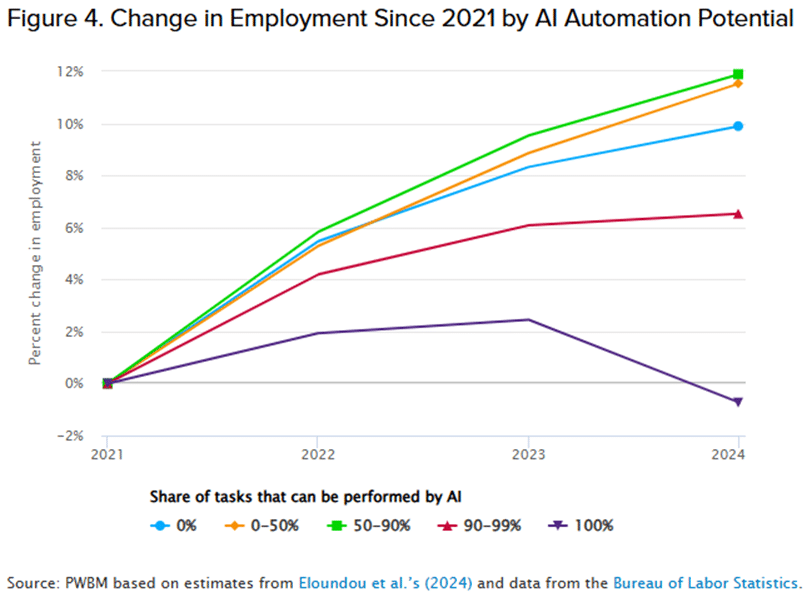
- Employment has slowed in AI-exposed occupations, suggesting early substitution effects, though fully automated jobs represent only about 1% of total employment so far.
- Generative AI is currently generating 25% average labor cost savings (for the tasks/jobs where AI is adopted) & this is expected to rise to 40% over the coming decades as tools improve.
- Preliminary estimates suggest AI could reduce federal deficits by $400B between 2026 & 2035 through productivity-driven growth & cost efficiencies.