

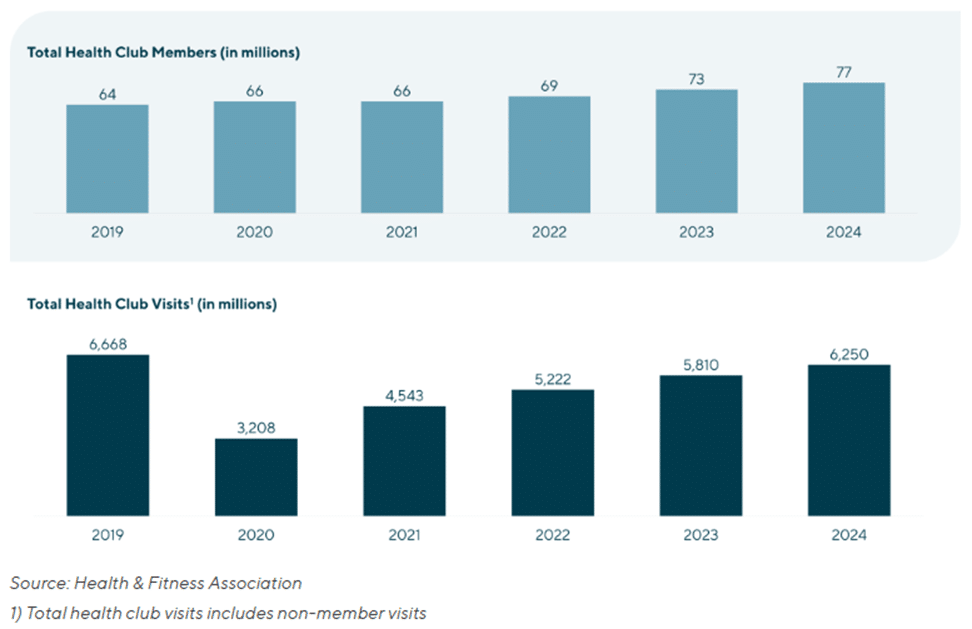
According to Lincoln International’s State of the Fitness Market: 2025 Edition, the global fitness market entered 2025 with renewed momentum as gym memberships & club visits climb above pre-covid levels. Consumers are redefining fitness through a holistic lens – combining strength training, recovery & wellness experiences – with technology, wearables & personalization reshaping engagement. High-Value, Low-Price (HVLP) gyms & premium wellness clubs are capturing growth, while mid-tier operators face consolidation pressures. M&A activity remains strong, driven by investor demand for scalable, tech-enabled platforms. Future winners will excel in digital integration, hybrid gym/home experiences & operational efficiency as fitness becomes central to modern health & lifestyles.
Learn More About NoBull Consumer Research’s Fitness/Gym Research
Key Points
- The fitness industry entered 2025 with strong momentum following years of transformation & normalization post-covid.
- Health club (gym) membership in 2024 was 77MM (+6% y/y) & club visits rose +8% indicating growing consumer commitment.
- Consumers are evolving how they think about fitness as something more than just workouts, but also holistic wellness (mental health, recovery, social connection) which is increasingly integrated into offerings.
- Strength training/resistance/functional movement programming is growing rapidly, and gyms are reallocating space away from traditional cardio toward free weights & functional zones.
- Recovery modalities (cold plunge, compression, red light therapy, etc.) are gaining traction.
- Wearables, AI & personalization are increasingly embedded in the consumer experience as fitness ecosystems are becoming more data-driven & integrated.
- The industry is bifurcating:
- High-Value, Low-Price (HVLP) gyms (Planet Fitness, Crunch) continue to gain scale by leveraging affordability, high membership volumes & tiered pricing.
- Premium operators (Equinox, Lifetime) are building differentiated value via bundled services (wellness, concierge, recovery, nutrition) to command higher per-member revenue.
- Mid-tier/ middle fitness operators are under pressure & many are being forced to specialize, differentiate, or consolidate to survive.
- M&A in fitness remains robust with 70+ global transactions during 2024 signaling strong investor interest.
- New investor entrants are entering the sector, pushing up valuations & competition for high-quality assets.
- Regional HVLP systems are ripe for consolidating & roll-ups as capital seeks scalable platforms.
- Boutique concepts (Pilates, yoga, strength-specialty) are expected to transact more in 2025.
- Older or lower-quality gym locations (“1.0” assets) face valuation discounting.
- The fitness product sector (equipment & wearables) face short-term headwinds from consumer pressure & geopolitical/tariff uncertainty.
- Some legacy operators haven’t recovered pre-covid membership levels, leading to distressed transactions.
- Incumbent brands risk irrelevance if they fail to evolve toward connected, tech-enabled ecosystems as new entrants redefine fitness. Increased competition & cost inflation may compress margins.
- The fitness industry is seen as well-positioned for continued expansion as fitness is increasingly central to broader health & wellness. Future winners will be those that: integrate tech & personalization; offer hybrid/connected experiences bridging in-club & at-home; excel in strength training, recovery & holistic fitness services; manage real estate & unit economics smartly; & navigate capital and M&A strategically in a competitive environment.
Source: https://www.lincolninternational.com/perspectives/articles/state-of-the-fitness-market-2025-edition/
