A discussion with a large, multi-unit QSR operator helps explain traffic losses and how to drive profit growth in a post-covid world.

A New Business Model for Restaurant Chains
read more

A discussion with a large, multi-unit QSR operator helps explain traffic losses and how to drive profit growth in a post-covid world.
The US$ has a serious problem. The Federal government spent $6.75T during FY24 but only took in $4.9T in tax revenue, leaving a $1.8T annual deficit. Spending cuts won’t get the job done, so we need a tax hike. Raise income taxes by nearly $2T, and we go into a depression. That’s where tariffs come in; we currently collect $86B in custom duties, which represents just 0.5% of our $16T in annual imports. This is blatantly unfair when we must pay 67% tariffs to import into China & 39% to import into the EU. If we can bring our import tariffs closer to 10%, then we can raise $1.6T in additional revenue. If the Fed can further lower interest rates by half, Uncle Sam’s annual interest expense drops by something like $500B and, presto, we balance our budget & bring back the U.S.$ from the brink. A resultant return of domestic manufacturing & a weaker U.S.$ could add higher-paying jobs & increase exports.
Amidst all the capital market turmoil, it is easy to lose sight of the restaurant industry’s real challenge. No, it does not have to do with tariffs since almost all of the industry’s supply is sourced domestically. Neither does it have to do with sector stock performance, which has become increasingly removed from financial performance. OK, surely it has to do with the health of the consumer? Especially as it relates to tariff-induced inflation? We will go out on a limb and state that while this factor is important (although there are key mitigating factors from tariffs that could benefit restaurants), it is not key to predicting long-term winners & losers in the restaurant space…
Financial dogma states that inflation comes from the Fed’s money printing alone. It has nothing to do with supply shortages, and we are asked to ignore the obvious fact that the Fed is not a bank that loans money directly to consumers – that is the job of the banks. However, the Fed does loan money to the banks & to the federal government when it buys U.S. Treasuries. Credit bubbles are created when the banks & federal government make malinvestments with the funds they do have, like when the banks make sub-prime auto & house loans available to consumers with bad credit or when Uncle Sam sends out billions of social security payments to dead people. We posit that the Fed could easily save the current economy by lowering interest rates if the banks agree to use appropriate underwriting standards and Uncle Sam agrees to stop its profligate spending (including the funding of very expensive wars in faraway places that clearly serve no benefit to Americans).
By converting from a full-service to a self-service format, Steak n Shake’s breakeven point declined by -40%, obviating its dependence on high AUVs to generate a profit. The average number of employees working per operating hour decreased by -29% & productivity increased +114%. Over the last 4 years, the company produced aggregate pre-tax operating earnings of $71MM. We really like the new franchise partnership option modeled after Chick-fil-A.
DraftKings posted a +13% y/y revenue increase, fueled by a record Super Bowl performance, rising sportsbook profitability & successful customer acquisition across Sportsbook, iGaming & digital lottery. Strategic bets on live betting & product innovation support FY25 revenue guidance of up +32% to +38%.
Third-party restaurant traffic data (cell phone tracking) revealed a material decline during January & February, alarming many investors who are concerned that the drop may not be attributed to weather after all. At the same time, U.S. commercial gaming revenue expanded in January by +11.9% y/y as the combined revenue from traditional casino games, sports betting, and iGaming reached $6.5B (a new January revenue record). Same demo as QSR, any wallet share connection?
The US$ has a serious problem. The Federal government spent $6.75T during FY24, but only took in $4.9T in revenue, leaving a $1.8T annual deficit. Since it is nearly impossible to cut spending because of institutional inertia & the prospect of raising income taxes by close to $2T/year would send the U.S. into a depression, there doesn’t seem to be a way for Uncle Sam to avoid a default… This is where tariffs come in. The U.S. imports $16T annually (54% of our total $29.7T GDP). A 20% tariff across the board could raise $3.2T in additional taxes – wiping out the deficit with enough left over to lower income taxes by $1T. This is like value-added consumption taxes (VAT) on goods & services collected by 175 countries (including EU member states). Yes, prices go up, but domestic manufacturing comes roaring back as companies seek to gain a price advantage by avoiding tariffs, bringing back high-paying jobs that have been offshored over the last several decades. Long-term GDP growth should accelerate & the U.S. has the potential to export some of what it manufactures domestically. Not only is it a reasonable plan, but we may also have no other choice!
We don’t think all the tariff saber-rattling will hurt restaurant margins…
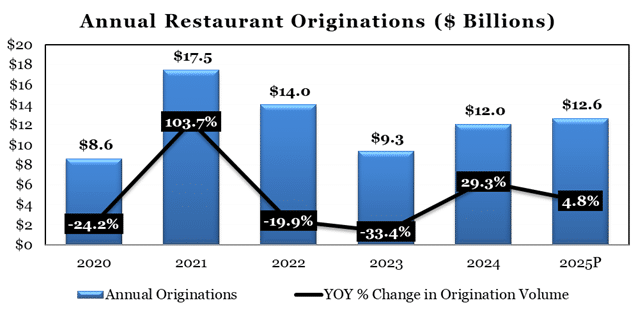
2024 loan origination volumes normalized after a temporary halt in new originations due to increased regulatory scrutiny resulting from the March 2023 banking scare (Silicon Valley Bank & Signature Bank failures).


Nobull consumer research weekly

Get Corporate & Market Insights in your inbox


A Restaurant Research LLC Company