

According to the EIA’s 5/22/26 Weekly Petroleum Status Report, U.S. crude oil inventories are only -2% below the 5-year average for this time of year while total motor gasoline inventories decreased by -2.6MM barrels from last week & are -6% below the 5-year average for this time of year. While this doesn’t sound so bad, the national average retail price for regular gasoline increased +42% y/y to $4.475/gallon while diesel was up +58% y/y to $5.523/gallon.
Insights
- Refineries are running hard (94.5% utilization) & increased gasoline production to 9.9MM bpd is intended to help alleviate supply concerns, helping to provide some short-term wholesale gas price relief.
- In any case, total petroleum inventories declined by a sizable -8.3MM barrels, indicating demand is still outpacing supply replenishment. Imports remain weak, further limiting inventory rebuilding.
- Retail gasoline prices typically lag wholesale moves by 1-3 weeks & with inventories below normal heading into peak driving season & if inventories fall from -6% to (-10% to -15%) below normal over the summer, retail gas prices could rise much faster than the inventory decline would suggest because the market would begin pricing in shortage risk rather than merely tight supply.
- Historically, when inventories become critically tight, retail gas prices become highly convex & a -5% to -10% additional inventory draw can trigger a disproportionately large price response because consumers cannot easily reduce driving & refiners have little spare capacity. In that scenario, a crude move from $100 to $110-120/barrel combined with inventories -15% below normal could produce $5.50+ national average gasoline, with some regions substantially higher (notably, Walmart recently warned that consumer demand weakens meaningfully above $4.50–$5.00 per gallon).
- ExxonMobil SVP Neil Chapman recently reported that global oil reserves are being drawn down at the fastest rate on record, setting the world on course for sudden shortages & even more sharply higher prices. “We’re approaching unheard-of inventory levels. You can debate whether that’s going to hit in 2 weeks or 3 weeks. Once you get to that point, you’ll see prices shoot up. When prices get to a certain level, demand destruction brings it back into balance". Yikes!
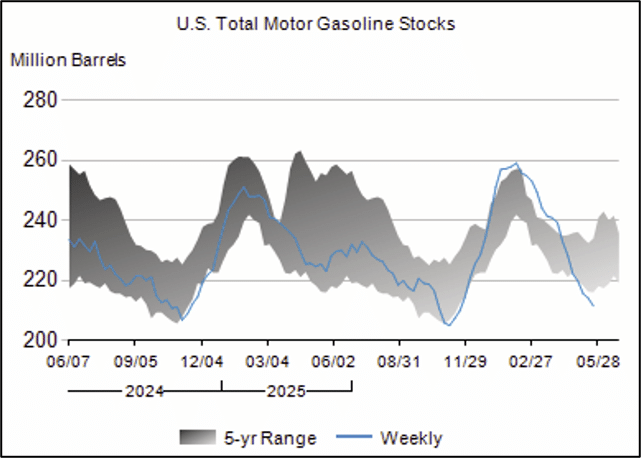
Source: Weekly Petroleum Status Report
