Key Insights
- The U.S. economy remains resilient, with real GDP expected to grow around +2% in 2026, supported by record AI-related capital spending, fiscal stimulus & healthy corporate investment, even as consumer spending gradually slows.
- While consumer demand is supported by a stable labor market & elevated household wealth, higher gas prices & moderating income growth are weighing on lower-income households.
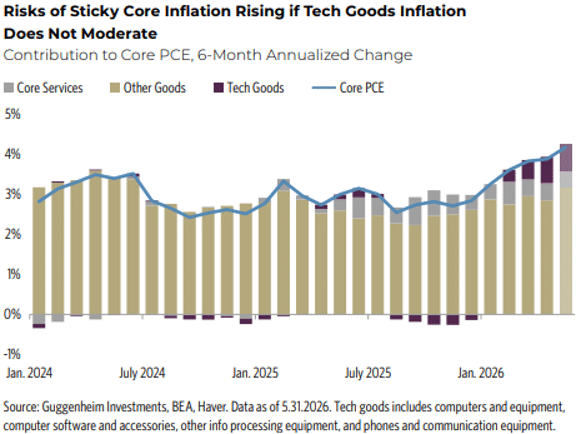
- AI has become the primary engine of U.S. economic growth, driving massive investment in data centers, semiconductors, construction & power infrastructure. While this investment is boosting GDP & corporate earnings, supply constraints in memory chips, electricity & computing infrastructure are creating new inflationary pressures that could keep tech prices elevated.
- Guggenheim expects inflation to moderate later this year as tariff effects fade, housing inflation cools & energy price comps become easier.
- Energy markets have stabilized following the reopening agreement for the Strait of Hormuz. While the worst supply disruption has likely passed, oil inventories remain depleted & transportation, freight & diesel costs are expected to stay above pre-war levels.
- The Fed is expected to remain on hold through 2026, but policymakers have become noticeably more hawkish as inflation risks persist.
- Treasury yields are expected to remain range-bound at elevated levels, supported by resilient economic growth, persistent fiscal deficits & ongoing inflation uncertainty.
- Corporate credit fundamentals remain healthy, but tight credit spreads leave investors increasingly reliant on careful security selection as AI investment creates wider performance dispersion across industries.