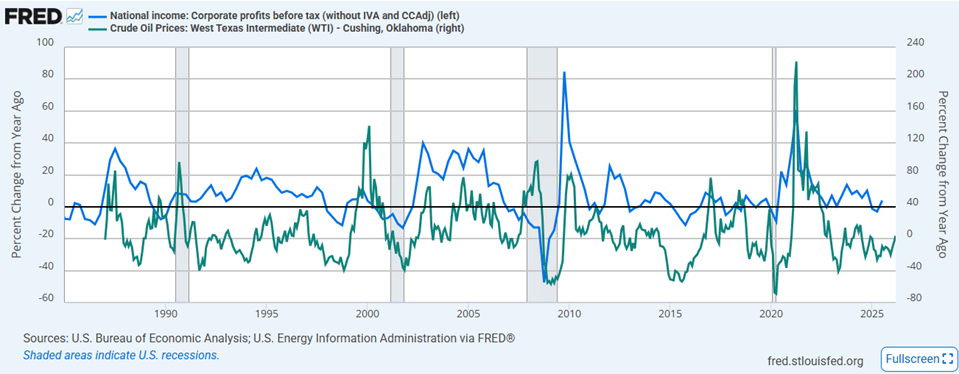
The bears are quick to point out that $100 oil paints a devastating picture of stagflation, with higher prices driven by freight cost increases & slower economic growth as consumers are pressured by higher gas bills. We suggest that interest rates have a lot more to do with the financial health of consumers & corporations than oil prices which are becoming less relevant in today’s economy. In other words, the Fed may have become more important than Middle Eastern countries to our economy… You want lower oil prices? Just ask the Fed to keep interest rates elevated sufficiently to cause a recession & oil prices will drop quickly enough!
Insights
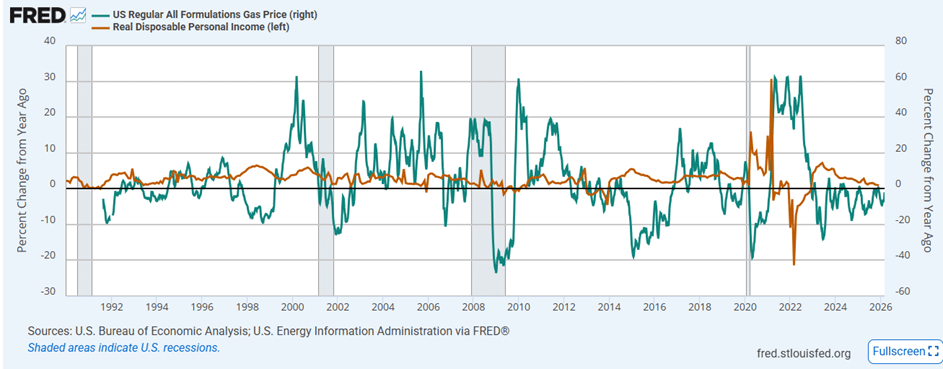
- The EIA reported during 9/25 that it expects U.S. drivers will spend less than 2% of their personal disposable incomes on gasoline in 2025 which is the lowest share since 2005, excluding 2020 (2.4% over the previous decade & as high as 4% during the 2008 oil spike). The correlation between gasoline prices & U.S. real disposable income from 1990–2025 is generally weakly negative in the short term & close to zero in the long term. This partially reflects several structural changes which include: services dominating consumer spending, improved fuel efficiency & an increase in domestic shale production (adding supply as needed). Consumers can also adapt by driving less & adapting more quickly to EVs. Rather, gas prices seem to have an outsized impact on consumer sentiment relative to their small budget share.
Financial Performance & Guidance
- Higher oil prices can increase corporate profits (although the correlation is not strong) because it usually signals strong economic growth. During the 1999 – 2008 commodity supercycle (oil $20 → $140) corporate profits surged & during the 2008 financial crisis both oil & corporate profits collapsed (recessions are what typically drive lower oil demand & prices).