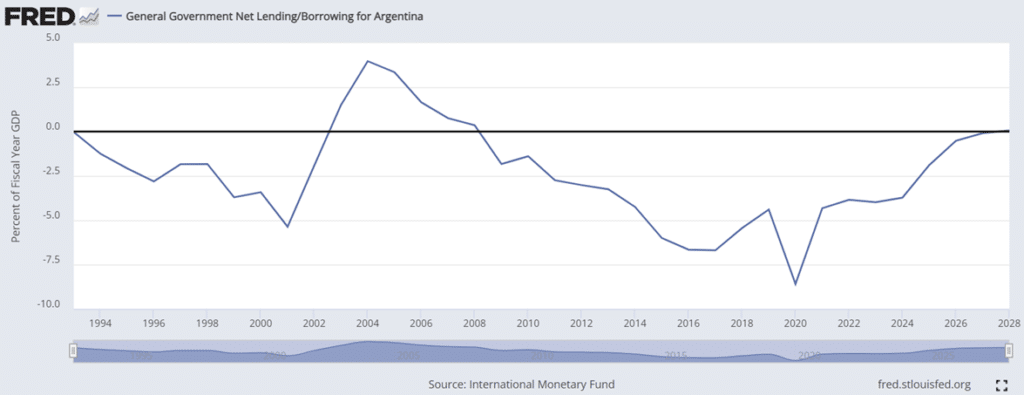
Argentina’s newly elected President Javier Milei (a trained economist) was able to implement a plan to help his country avoid a certain destiny with hyperinflation & default by implementing a radical economic plan centered around: severe fiscal tightening; the removal of foreign exchange restrictions & the implementation of a “dollarization”; and the privatization of state-owned enterprises. After 1 month in office, Argentina was able to generate a $589MM government surplus!
The Plan
- Argentina’s newly elected President Javier Milei (a trained economist) & his Economy Minister, Luis Caputo, set out to address their country’s: fiscal deficit which had grown to 5.5% of GDP; inflation approaching +200%; and $100B in crippling debt.
- They started out by setting the official exchange rate at 800 pesos per US$ (vs. 366) in an attempt to move towards the 1,000 rate in 2019 before Argentina implemented strict capital controls. While this will increase the cost of imports, it will encourage producers & exporters.
- Further, the state shrunk its total workforce by 1/3, cutting the number of ministries in half to 9 & reducing secretariats to 54 from 106.
- Subsidies for energy & transportation were reduced & subsidies for media companies were suspended.
- Instead, Argentina's universal child allowance plan was doubled & the government’s food card program was increased by +50%.
Initial Results
- The Argentine government in January saw its first monthly budget surplus in 12 years, ending with a $589MM positive balance for public-sector finances.
- Milei is negotiating with the International Monetary Fund over its $44B loan & expects to achieve a balanced budget this year - "The zero deficit is not negotiable" according to his Economy Minister.
- With 45% of his population in poverty, Milei must move fast. However, if the country can be sufficiently patient to see through the full implementation of his plan, Milei’s economic leadership could mark a historic shift away from the economic devastation caused by socialism across the world & especially in countries in the Southern Hemisphere. Hopefully, economic leaders in the U.S. are paying attention!