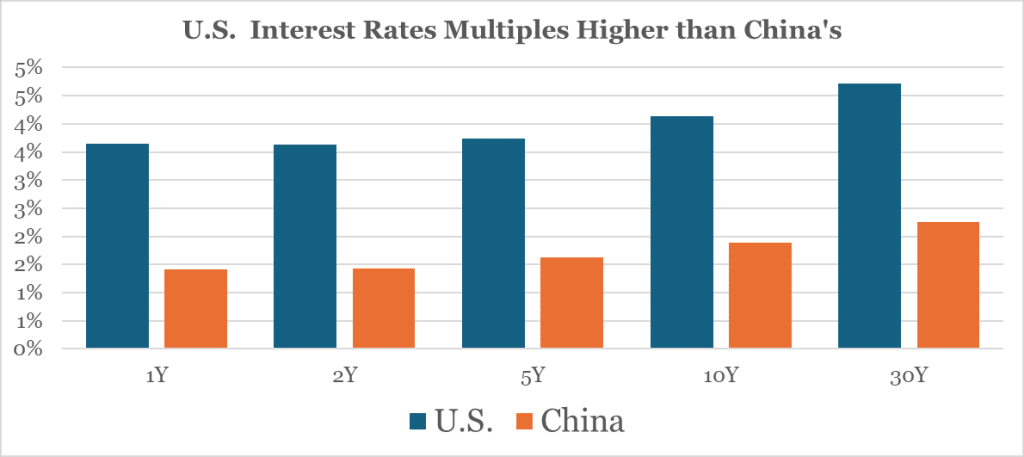
What’s good for the goose is good for the gander. There has been a huge amount of discussion around if and how much the Fed should cut. However, a more informed, broader discussion would consider a global comparison of interest rates to see where the U.S. should be. Rather than looking at Fed Fund rates, we look at sovereign debt rates by tenure (1 year – 30 years), and we find that the U.S. short-term rates are significantly higher than the ROW (rest of world average). More so, we believe that the most accurate way to benchmark the U.S. is to compare rates with China (the second-largest economy in the world). There is a big difference! Let’s learn from the Tiger…
Key Points
- Sovereign interest rates can support or detract from currency value. Higher interest rates attract more foreign investment, supporting a country’s currency value.
- The U.S. has historically supported a strong US$, which is evident by relatively high interest rates as outlined in the table below. This helps the US$ maintain its position as a world reserve currency.
- However, a strong US$ is more beneficial for imports than exports & this helps explain our substantial trade deficit (-$918B during 2024). The current administration seeks to balance trade & this requires lower interest rates and a weaker US$.
- This is consistent with the strategies of the export-reliant nations (particularly China & Japan).
- Higher sovereign rates can also be a sign of a country’s weak credit, as we can see below with the UK & India (Fitch recently cited India’s high levels of fiscal deficits & debt that would require +10% nominal economic growth to solve vs. expectations of +6.5% real growth during 2026, unchanged from 2025).
- This is not likely the case for the U.S., which remains the best credit risk in the world for the time being.
- In conclusion, lower U.S. rates, which are easily justified by a global comparison, would help Americans at home as we pivot away from our post-WW2 role as nation builders.