
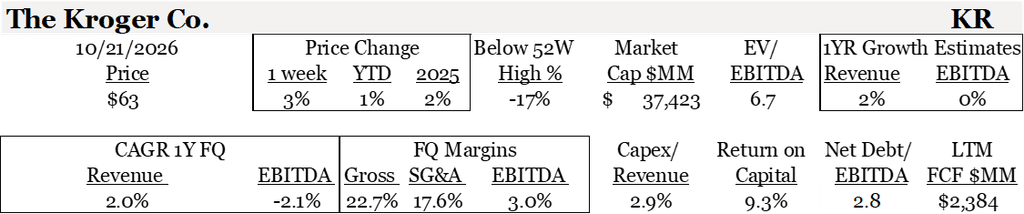
Kroger is targeting +3% comparable sales growth (excluding fuel & pharmacy) in 2029 which is expected to be driven by lower prices, private-label (Our Brands) expansion and digital growth. Management plans $4B in annualized cost savings by 2029, which will help fund a $5B investment in lower retail prices (better customer value) and support margin expansion. Kroger targets a +3% to +6% adjusted EBITDA CAGR and a +7% to +11% adjusted EPS CAGR for FY2027–FY2029.
Insights
- Price-sensitive consumers with constrained household budgets are prioritizing everyday value, simpler promotions & affordable meal solutions.
- Grocery competition is intensifying as retailers lower shelf prices to capture market share.
- Fresh foods, prepared meals & private-label products are gaining importance as consumers seek convenience, affordability & healthier choices.
Positioning
- Kroger is investing $5B in customer value through 2029 which will be funded by $4B in annualized cost savings & promotional efficiencies.
- The company is expanding prepared meals, driving private-label penetration toward 40% & planning 110 new stores by 2029.
- E-commerce profitability should benefit from faster fulfillment, AI personalization & higher-margin retail media.
Financial Performance
- Kroger is targeting +3% comparable sales growth, excluding fuel & pharmacy, by 2029.
- Early pricing investments delivered +230 bps sales outperformance in stores operating under the strategy for one year.
- Management is targeting +3% to +6% adjusted EBITDA CAGR through 2029, supported by $4B in annualized cost savings, private-label expansion & improving e-commerce profitability.
- Adjusted EPS is projected to grow at a +7% to +11% CAGR from 2027–2029, with growth expected to accelerate as the company's pricing investments mature.
- CapEx is expected to reach $5B in 2029 which is needed to fund new store development, digital fulfillment & supply chain modernization.
