
The persistent decline in guest traffic across much of the U.S. restaurant industry since covid increasingly appears to reflect a structural imbalance rather than a cyclical slowdown. While industry players have largely focused on menu price inflation, consumer fatigue, or shifting preferences, a more compelling explanation is that the industry has too much capacity relative to its long-term demand base. Same-store traffic has remained negative across many publicly traded restaurant chains despite historically low unemployment, rising household incomes & resilient consumer spending. In previous economic expansions, these conditions would typically have supported positive traffic growth. The fact that they have not suggests that the industry's supply-demand equilibrium has fundamentally changed.
During the decade preceding covid, restaurant supply expanded rapidly. Low interest rates, inexpensive capital, franchise development & private equity investment encouraged virtually every major concept to pursue unit growth. Chains increasingly viewed market share gains as synonymous with opening additional restaurants, while many local markets became saturated with overlapping concepts competing for the same customer occasions. Although covid temporarily reduced industry capacity through independent restaurant closures, the subsequent recovery restored much of that supply as chains resumed development & new concepts entered the market.
Demand, however, has evolved differently than many operators anticipated. Restaurant menu prices increased dramatically between 2021 & 2024 as operators passed through higher labor, commodity, occupancy & supply chain costs. Revenue growth remained healthy because pricing more than offset lower transaction counts, but consumers gradually adjusted their behavior. Rather than eliminating restaurant spending entirely, households reduced visit frequency, traded down across occasions & became more selective about where they dined.
Demographics further reinforce the structural nature of the problem. The industry's strongest growth period coincided with Millennials entering their peak consumption years, driving elevated demand for both quick-service and casual dining concepts. That demographic tailwind is fading & U.S. population growth has slowed materially over the past decade, fertility rates remain near historic lows & the population is aging. Older households generally dine out less frequently than younger consumers, while younger generations face higher housing costs, elevated student debt & greater financial constraints that reduce discretionary spending. Even as total consumer expenditures continue to rise, the number of restaurant occasions per capita may no longer support the industry's existing footprint. Further, remote work has altered traffic patterns by reducing weekday lunch demand in many urban business districts while dispersing spending into suburban markets. Consequently, the geographic distribution of restaurant capacity no longer aligns as efficiently with where consumers actually live & work.
The competitive landscape has also broadened considerably. Restaurants no longer compete solely with one another but increasingly with grocers offering restaurant-quality prepared meals, warehouse clubs, meal kits, convenience stores, food delivery platforms & home cooking facilitated by digital grocery services. These alternatives have permanently increased competition for meal occasions while simultaneously raising customer acquisition costs for restaurant operators.
From an economic perspective, the industry's persistent negative traffic can be viewed as evidence of excess capacity. Restaurant demand has likely reached a plateau while supply continues to exceed sustainable levels. Because restaurants operate with high fixed costs & relatively low utilization outside peak meal periods, even a modest oversupply can materially pressure AUVs. Unlike manufacturing, where excess inventory can be reduced, restaurant capacity remains largely fixed until locations close.
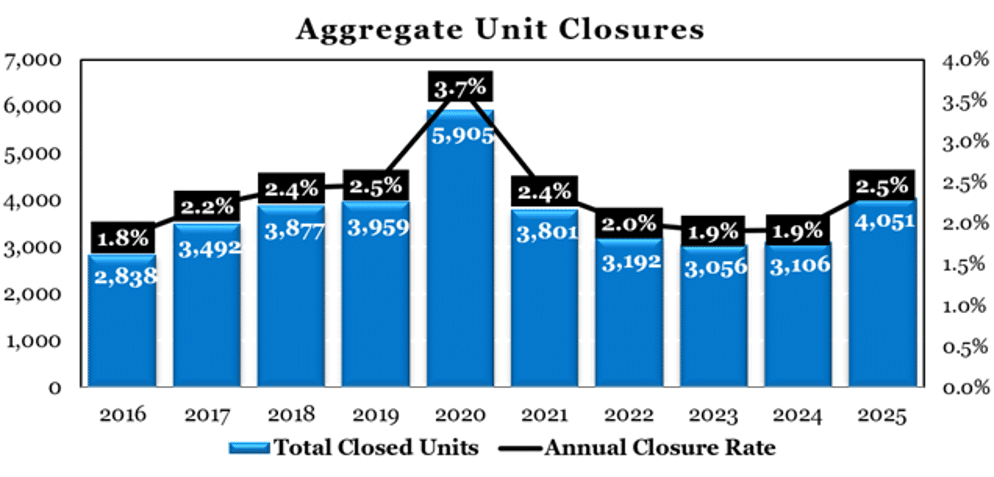
Estimating the magnitude of excess capacity is inherently imprecise, but industry performance suggests the imbalance may be meaningful. If normalized demand today is approximately -10% below the level implicitly assumed by the industry's current footprint, then a cumulative reduction of approximately -10% to -15% of U.S. restaurant units over the next 5 years would likely restore healthier average restaurant volumes & improve traffic trends for remaining operators. Should demographic growth continue to slow & the previously discussed external pressures continue to increase, a larger rationalization of -15% to -20% may ultimately be required.
Fortunately, new unit development has already moderated across many major brands, while bankruptcies & permanent closures have accelerated among financially weaker chains. In any case, as evident by the chart below, more closures going forward are likely necessary than we have seen over the last decade.
For stakeholders, the implications are significant. Rather than assuming traffic weakness reflects temporary consumer caution, it may be more appropriate to view current conditions as a multi-year capacity correction. Chains with strong balance sheets, differentiated brands, high average unit volumes & disciplined development strategies stand to benefit disproportionately as weaker competitors exit the market. Conversely, brands pursuing aggressive unit expansion into already saturated markets may continue to experience declining marginal returns despite positive headline sales growth.
The industry's long-term outlook therefore depends less on the pace of consumer recovery than on the pace of capacity rationalization. Until restaurant supply more closely aligns with demographic realities & sustainable dining demand, widespread positive guest traffic is likely to remain elusive. The next phase of industry recovery may ultimately be defined not by stronger consumer spending, but by fewer restaurants competing for the same customer.
