
Insights
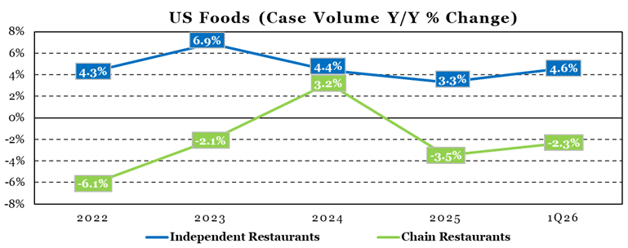
1Q results were not great and represent a continuation of restaurant chains traffic struggles. While it is true that weather disruptions were partly to blame during the quarter, there is obviously much more going on here. At the heart of the issue is whether the chains are simply too expensive or perhaps consumers are too poor, or more likely some combination of the two. In terms of price increases, a comparative look at McDonald’s menu boards in the Charlotte market from 2019 (pre-covid) to present reveals the massive changes. While a Big Mac combo only increased +20% from $6.89 in 2019 to $8.29 currently, lower income consumers in 2019 could choose from 2 cheeseburgers for $2, the $1 $2 $3 Dollar Menu or 2 for $4 Mix & Match breakfast deals. By 2026, 2 cheeseburgers cost $4.58 (up 2.29x) and that basically says it all. However, there are other factors in play as well. Firstly, consumers are more predisposed to eat at independent chains (refer to US Foods’ case volume chart below) which are nimbler & more adaptable to changing consumer preferences and more likely to offer on-trend flavors & food options. This trend is certainly driven in large part by changing demographics as the aging boomers are replaced by Gen Z (boomers were great chain customers & brand loyal while Gen Z are less interested in chains and less brand loyal). Not only this, but both the younger & older generations are more interested in health-oriented options which are largely absent at the legacy chains. According to GWI, the $2T U.S. wellness economy is the largest in the world & accounts for $6k/person annually. Gen Z also like specialty caffeinated beverages (7 Brew & Dutch Bros) and are more likely to substitute one for a meal. To McDonald’s credit, the chain is finally moving in this direction with its new McCafe platform. In any case, we recently proposed that a “great reset” is in order for the restaurant industry and now maybe the perfect time for the legacy chains to close ~10%+ of their underperforming locations simultaneously to help boost traffic at their remaining restaurants. With restaurant stocks currently in the tank, investors are unlikely to punish companies willing to optimize their systems in pursuit of an opportunity to start fresh. Legacy chain closure rates could & should be higher and 60-year-old chains must be involved in a steady cycle of creative destruction (closures & relocations are often preferable & necessary as opposed to simple remodels). What is the useful life of a restaurant? 30 years? Notably, the great reset must go beyond store closures & must incorporate new operating models which will allow for a quicker adaptation to constantly changing on-trend consumer preferences (including more healthful options), better service & hospitality and more effective marketing models to reach Gen Z online where they live. The hard part is getting started 🤔, let’s go!
Learn More About RR Subscription
Order Report
