
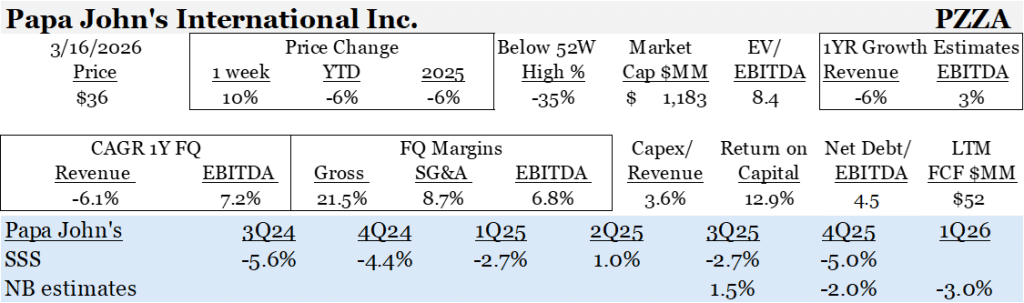
Papa John’s is accelerating its transformation strategy through menu innovation, digital investments & stronger value positioning to attract new customers & rebuild traffic. The company continues expanding its loyalty program, simplifying operations & optimizing its restaurant base while growing internationally. Management expects a soft start to the year, with North America sales projected to decline -2% to -4% amid ongoing consumer spending pressure.
Insights
- The QSR pizza category is growing more slowly than past trends as competition expands from alternative pizza channels (convenience stores, retail & frozen pizza).
- Value-driven offerings & promotional pricing remain critical to driving traffic.
- Fuel prices, lower disposable income & tighter consumer budgets continue to pressure restaurant spending & trade down behavior.
Positioning
- Rebuilding brand relevance with stronger value positioning, improved innovation & enhanced operations.
- Accelerated product innovation includes pan pizza, sandwiches & single-serve pizza offerings.
- Papa Pairings mix-and-match offerings & promotional entry-price items drive trial.
- Removal of Papadias & Papa Bites improves kitchen efficiency & peak-hour execution.
- Marketing combines national campaigns with local marketing co-ops.
- Papa John’s Rewards program reached 41MM members & generates significantly higher frequency.
- Plans to expand first-party digital ordering while also competing on third-party aggregator platforms.
- Tech investments include app improvements, Google Cloud ordering integrations & a full POS system replacement (partnership with PAR).
- Fleet optimization initiatives include closing underperforming restaurants, refranchising company units & consolidating franchise territories. International growth remains a major expansion driver.
Financial Performance & Guidance
- The company expects 1Q to be the weakest quarter of the year, with performance improving as innovation launches & marketing initiatives ramp through the year.
- North America sales are expected to decline -2% to -4% for the year, primarily driven by transaction pressure.
