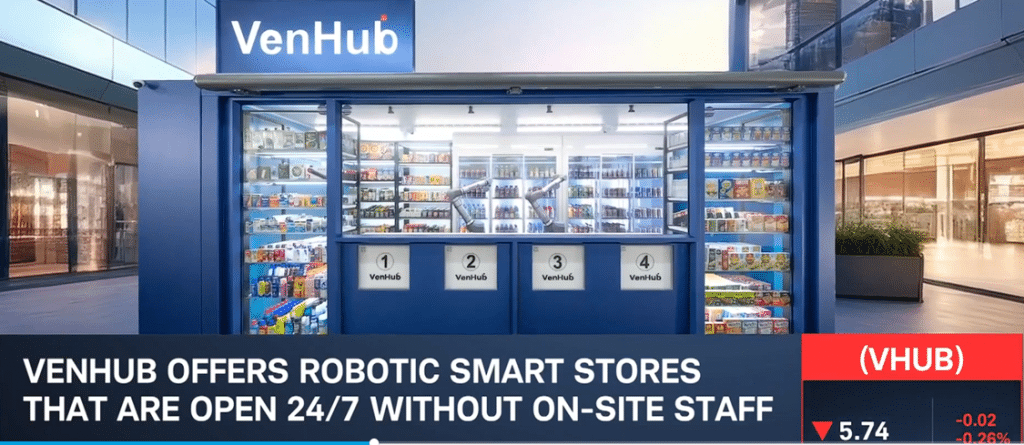
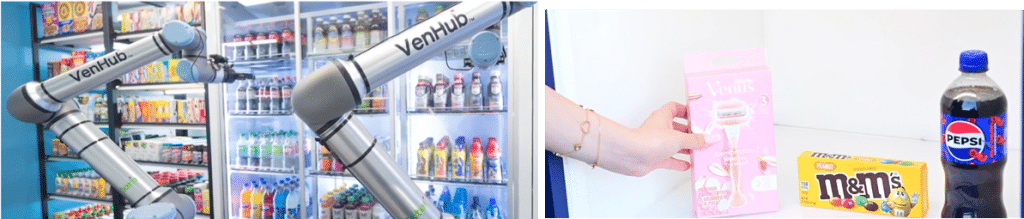
VenHub operates an asset-light model, selling fully built, turnkey robotic convenience store units. Customers are responsible for inventory, restocking, pricing & day-to-day operations, while VenHub generates revenue through upfront unit sales, recurring software & AI platform fees, and ongoing maintenance & servicing. This structure shifts labor & inventory risk to customers, positioning VenHub as a tech & infrastructure provider rather than a traditional retailer. Notably, VHUB shares declined heavily post-IPO, reflecting the overall speculative nature of the investment (the company has minimal revenue history having deployed only 4 stores so far).
Key Insights
- VenHub builds fully robotic, employee-free convenience stores, positioned as a hybrid between a vending machine & an Amazon Go-style (checkout-free retail) experience.
- The company’s clients handle restocking & daily operations while VenHub generates revenue from unit sales, cloud & AI inventory software, maintenance & recurring service fees.
- The estimated build cost per unit is $250K to $400K vs. $750K to $1.5MM for traditional convenience stores.
- Each store supports 300 to 1,600 SKUs, ranging from food & essentials to medication.
- Robotic arms fulfill app-based orders & dispense items through vending-style doors. VenHub says its robotic arms can recognize bottle-shaped products at a 99% rate.
- VenHub targets 24/7, high-traffic locations such as transit hubs (Los Angeles Union Station) & college campuses. As of late 2025, there were only 4 stores operational, though management references $300MM+ in potential revenue from pre-orders & estimates a $2T total addressable market (1MM global c-stores).
- The company projects $46K in annual recurring revenue per store.
- VenHub plans to add digital advertising panels & expand packaging compatibility.
- The company will benefit from reduced direct competition (Amazon has exited its Amazon Go store operations due to profitability challenges).
- Notably, VHUB shares declined about -30% since the IPO, reflecting a mix of initial overvaluation, extreme early trading volatility, weak financial results & risk repricing.