

Amidst all the capital market turmoil, it is easy to lose sight of the restaurant industry’s real challenge. No, it does not have to do with tariffs since almost all of the industry’s supply is sourced domestically. Neither does it have to do with sector stock performance, which has become increasingly removed from financial performance. OK, surely it has to do with the health of the consumer? Especially as it relates to tariff-induced inflation? We will go out on a limb and state that while this factor is important (although there are key mitigating factors from tariffs that could benefit restaurants), it is not key to predicting long-term winners & losers in the restaurant space…
Signal vs. Noise
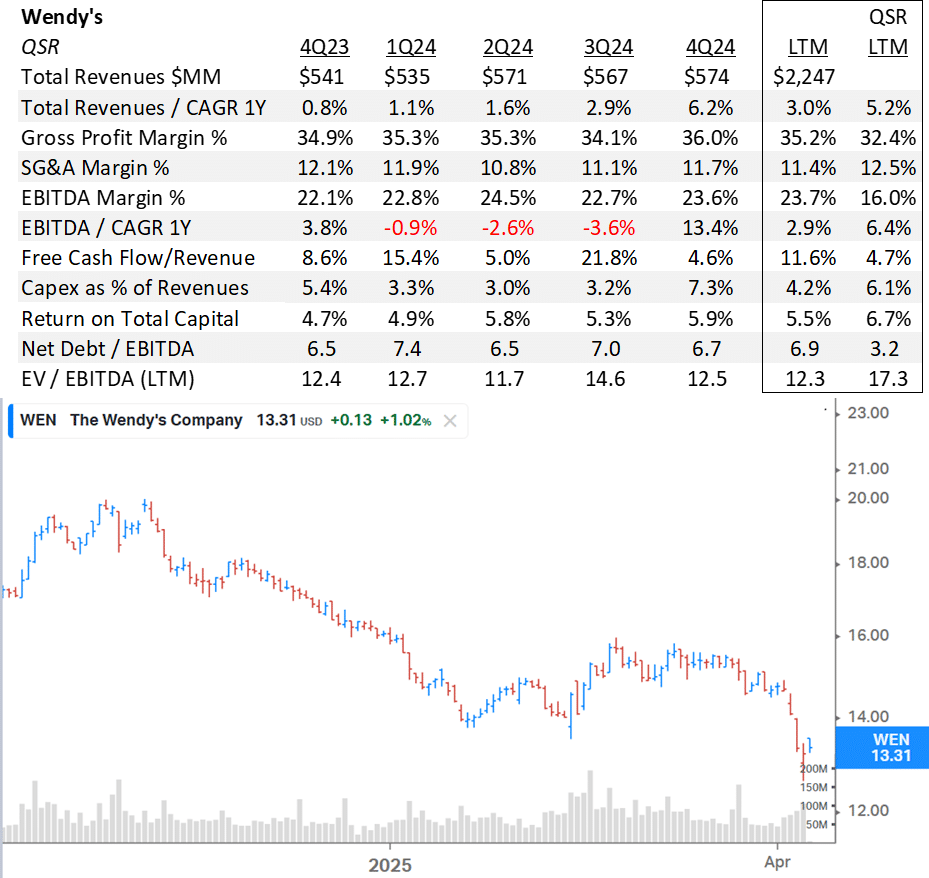
- Surely, Wendy’s improving financial performance justifies a drop in the WEN share price from just under $20 at the end of October 2024 to $13 currently?? Especially when they are guiding to +2% FY25 comp growth!
- We suggest that Wendy’s financial performance is signal & WEN share performance is noise!
How About the Consumer?
- We have been saying for quite some time that the consumer is employed & that counts for a lot. Lower-income consumers are certainly squeezed by elevated prices, but many (not all) consumer-facing companies reported some 4Q24 relief from the lower-income demo, although we do note weakness at the beginning of 1Q25. However, as we point out, 1Q25 was a good time for the nascent online betting business, which provides a clue about changing consumer spending preferences...
- How will tariff-induced inflation affect the consumer? This is unknowable given all the moving parts & the ongoing negotiations which bring both good & bad.
- Some mitigating factors to consider: some of the tariff tax may be absorbed upstream by companies interested in maintaining market share; sales mix may shift to less expensive domestic manufacturers; and consumers may simply forgo spending on expensive foreign produced discretionary items, potentially substituting their discretionary spend for things like restaurants & other local experiences.
- In any case, we posit that near-term consumer sentiment & strength is noise in comparison to the enduring habits and preferences (signal) that have changed post-covid, as we discuss next.
Signal & Forecast
- The covid lockdowns likely changed consumer habits & preferences permanently. It’s not that the consumer currently avoids sitting down with friends & family over a dine-out meal because of health concerns, but rather post-covid consumers (especially the younger demo) have been trained to initiate everything digitally and, if they can afford it, to have their food delivered to their door.
- The new Netflix/mobile phone generation now does everything on their couch. Worst case, they must drive to pick up their meal.
- Some consumer-facing companies (including restaurant chains) have adapted to the new market realities & enjoy healthy financial results in an otherwise weak market. Notably, financial health for legacy brands in the post-covid world is marked by the ability to maintain profits, perhaps more than the ability to grow profits for the time being. A lot of capex is required to reposition legacy brands & not all are willing to risk their capital.
- So, how to forecast all this? Given all the moving parts, it is clearly unwise to try to forecast industry traffic & sales trends. These types of forecasts are more useful during periods of stability when results are likely to follow historical trends.
- We suggest that lenders, investors & operators use our adaptation framework to predict winners and losers in the restaurant space. In other words, those chains that are making the necessary (and often painful) changes to optimize for the Netflix generation are best positioned. This also includes optimizing their cost structures to deal with traffic declines (please refer to the Steak n Shake case study here).
- Please keep up with your RR/NoBull reports as we apply this adaptation framework in our analyses to help our clients assess which companies are best positioned in today’s rapidly changing world.
