

VP Kamala Harris recently promised a “first-ever” federal ban on food price-gouging that would include “new penalties for opportunistic companies that exploit crises & break the rules.” She did not provide further details. We assess “price-gouging” with 2 different metrics: a comparison of food CPI (retail) vs. food PPI (wholesale); and a historical trend analysis of Kroger’s gross & operating income margins. Over the long term, the market is far too competitive to allow price-gouging which means Uncle Sam needs to look for someone else to punish for food inflation…
Big Picture
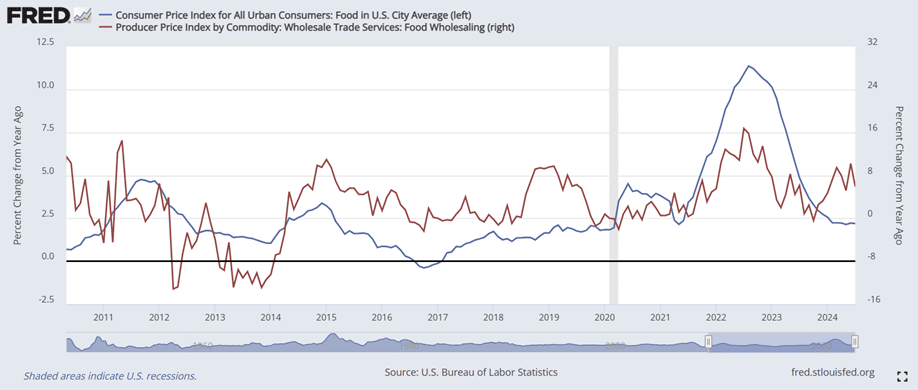
- As we can see from the chart below, there are regular cycles of imbalance between retail & wholesale price increases – sometimes the wholesalers (red line) have the upper hand over the retailers (blue line) and vice versa. That’s the way the market works, excess profits attract competition which drives a return to equilibrium.
- It is notable that there appeared to be some “price-gouging” that started towards the end of 2021 & lasted for 1.5 years after the government handed out its free covid bucks to U.S. consumers. However, after the retailers shared in this short-lived largesse, they are currently back to their normal position of having to absorb at least some of their wholesale cost increases.
- The chart below reinforces this idea & we see that Kroger (the fourth largest grocery chain) is not growing rich by price-gouging. It is fair to say that Walmart or Costco is far better able to penalize Kroger for such an indiscretion than Uncle Sam.

